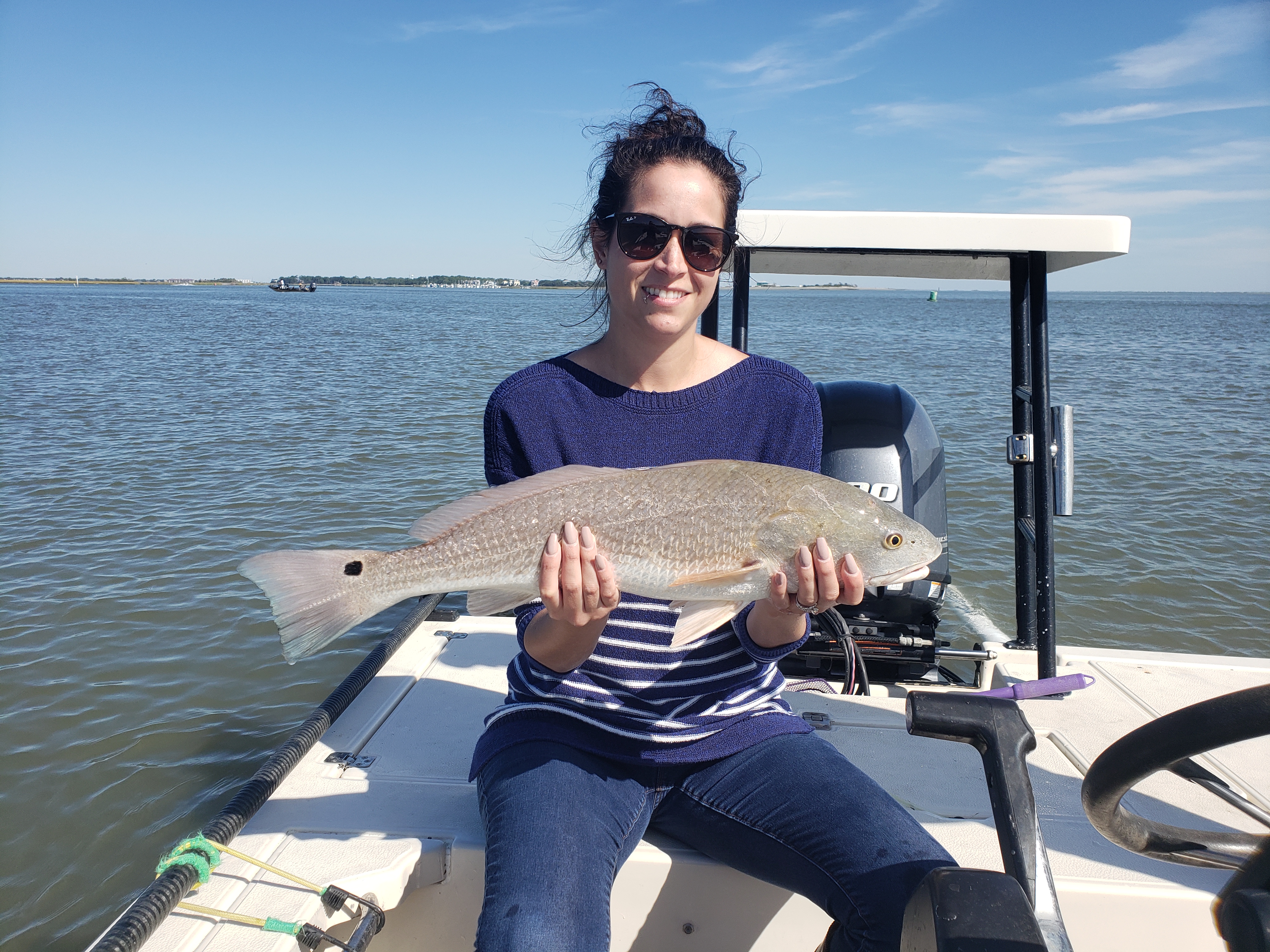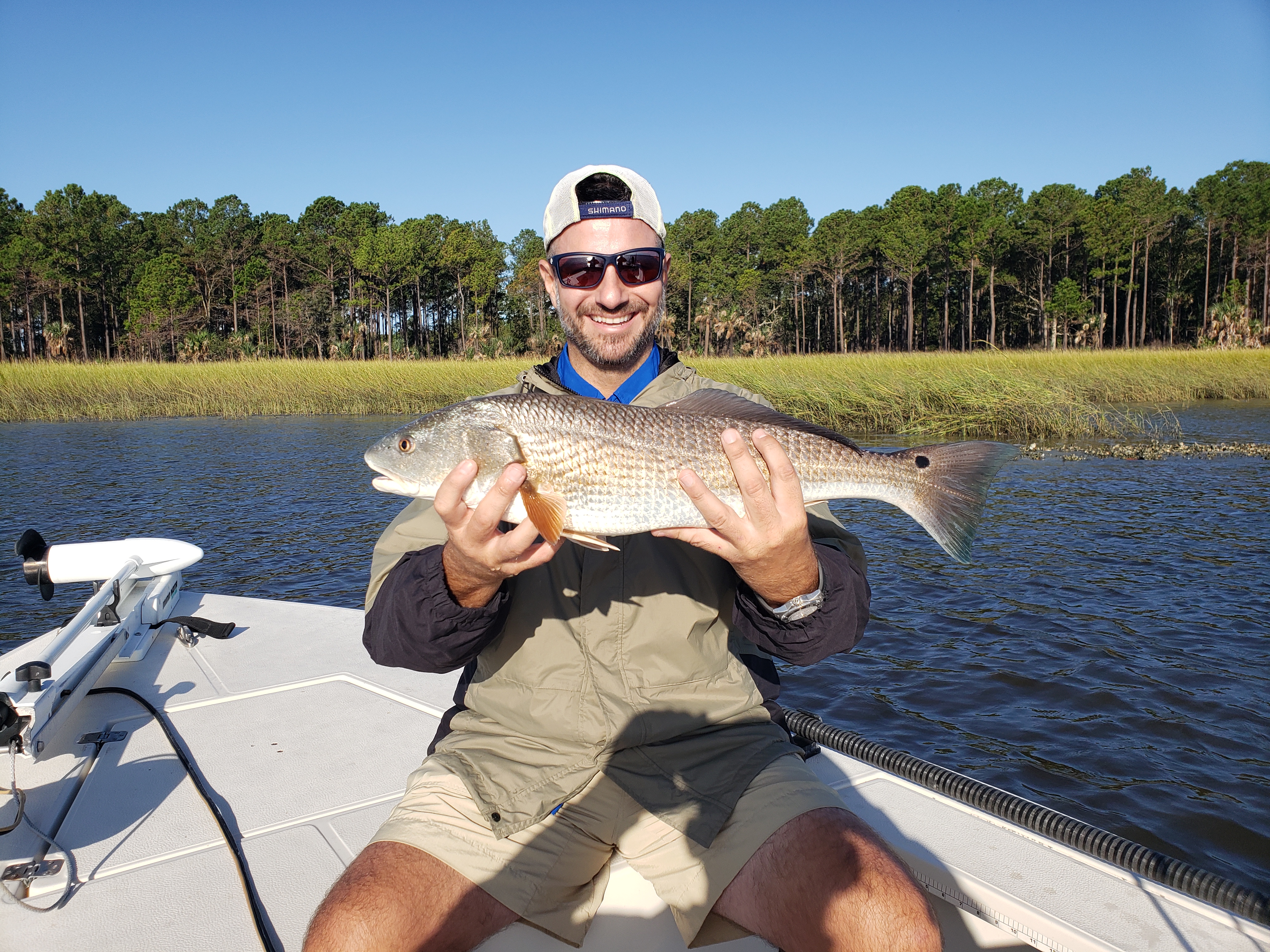
We started the charter with one big redfish, a 9lb. beauty, and the trip just picked up from there. Our next stop produced several reds and a weakfish from under a dock. Moved to another dock and caught at least a dozen more reds with multiple double hookups. Everything caught on mud minnows either on the bottom or on jig heads. As we headed for home, we left them biting!
We left out of Folly Beach this morning hoping to find some shelter from forecasted strong NE winds. Tucked away in a corner with the wind and current together, we found a great bite while pitching bait around structure. The return of cracked blue crab proved to be popular with the redfish and drew the most hits. Once the tide turned and the wind went against the current, the whole place shut down. However, not before Mike landed a nice ten pound redfish, his biggest ever!
Fishing a fast falling tide, we started out with docks but the water was rushing out too quickly. Once the water slowed down, we moved out onto the flats and set out cut mullet and mud minnows on the bottom. As a school of reds moved over the baits, the mullet rod twinged and then the mud minnow rod snapped over! After a long fight on a light rod, Miller brought the redfish alongside the boat. It weighed in at a healthy ten pounds and swam away healthy.
Gary, a regular client, loves to be casting as much as possible during his charters. After throwing artificials at hundreds of redfish only to see them sprint away, we agreed that putting out cut bait and waiting might be the best option. Boy, did it ever pay off! Our first fish was a huge 31″ redfish and was Gary’s biggest redfish ever. With this beauty in the bag, we switched back over to casting around docks with mud minnows on jigheads and caught smaller redfish for the rest of the charter.
Fishing this past month was great and we can expect November to be just as productive! Chilly nights remind redfish and trout that they had better eat now or it will be a long few months ahead without any food. Artificial lures have become very effective as natural bait leaves our waters. Take advantage of sunny days and go catch some fish!
As water temperatures fall, redfish have begun their seasonal phenomenon of forming large schools. Schools of fifty redfish will become common and they can swell as large as 100-150 during the winter. These fish are more wary this time of year and artificial lures can spook them on the flats. Instead of casting at the schools, we will throw out as many as three lines with chunks of frozen mullet on #3/0 circle hooks and let them sit. Eventually the redfish will find your bait and bend your rods over with some astonishing hits!
For trout, artificial lures are working very well. Trout hang together and when you catch one there will likely be others in the immediate area. Lures in hues of blue and gray are performing the best when paired with a 1/4oz. jighead. Remember to move your lure slower than usual as the fish slow down with the cooler water temperature. Try to bounce the jighead off the bottom and wait until you feel the pull of a striking fish.
Popping corks are still great options for both redfish and trout. Live shrimp can be used again with the bait stealers gone. I’ll attach a two to three foot leader to the cork and a size 1 circle hook on the other end with a split shot a foot above the hook. Cast along grass banks, over oyster beds, and at creek mouths and watch for that cork to disappear! It can be difficult, but when that cork drops, reel as fast as you can and let the circle hook naturally set itself. A big hook set can sometimes rip your bait right out of the fish’s mouth.
See you on the water!
Fall has arrived with cooler weather and shorter days. But don’t put your boat away just yet because we’re about to have the best fishing of the year! Fishermen can continue to find success with live bait but artificial lures should become increasingly effective. Take time to get out on the water, you won’t regret it.
Redfish have been eagerly eating live and cut bait fished on the bottom. Mullet are pervasive in our waters and can be easily netted while frozen bait can be used as a second choice. We’ll rig the bait on a size 3/0 circle hook paired with a carolina rig. You can use this setup under docks as well as on the flats. Just put the rod in the holder and wait for the reel to start screaming as the fish hook themselves.
Artificial lures have begun to really work for trout and the traditional paddle tail design has been great. I’ll use a 1/4oz. jighead and tie a loop knot to give the lure even more action. Vary your rate of retrieve as you search for fish. To make your lure even more seductive, try putting a piece of shrimp on the hook. You can use pieces of frozen or live shrimp and it will put a scent trail on your lure that is hard to resist.
Even as artificial lures become more effective, don’t stop tossing those popping corks. Mud minnows, live shrimp and artificial shrimp have been working well when suspended about two feet below the cork. Redfish and trout alike will eat these baits as they pass by suspended in the water column. Corks have been most effective when fished along grassy banks at mid and high tide.
With the lower temperatures, redfish are beginning to form bigger schools. These large schools make for excellent sight fishing and happy fly fishermen. On clear days, you can see these packs of redfish swimming in circles with their golden backs flashing in the sun. Take your time when approaching the schools and when you make your first shot make sure to cast to the edges so as not to spook the school.
See you on the water!
Rolled up onto the flat at first light and the schools weren’t hard to make out. Large halos of nervous water cruised up and down the bank sometimes punctuated by a noisy blowup of a redfish crushing shrimp. We posted up and waited for a school to come to us. Soon after, a large school swam in our direction and you could see the push of their backs in skinny water. Colin made a perfect cast putting a grey artificial fluke a few feet in front of the school. Almost immediately, there was a tremendous commotion and his drag screamed. Several minutes later he brought this 14 pounder alongside the boat. Wish all mornings started this way.
The perfect storm that makes for awesome fishing in the fall is about to begin. The combination of lower water temperatures, fewer fishermen on the water and tons of bait makes for ideal conditions. The arrival of cooler days that will make fishing much more pleasant doesn’t hurt either!
Popping corks are often mentioned in our reports. Why? Because they work so well! Redfish, trout and flounder will all eat bait that’s suspended in the water column. I’ll attach a 18”-24” leader from the cork to a size 1 circle hook. When fishing this rig, it’s very important to keep the slack out of your line so you can react quickly when the cork drops. I keep my rod tip pointed at the cork and just reel when it drops. You’ll find your hookup rate improves compared to keeping your rod tip high and trying to set the hook by jerking back on the rod.
It is time to bid farewell to the summer seasonal species who will likely be gone by the end of the month. Meanwhile, sharks are still providing plenty of entertainment for the next few weeks. When fishing in deep water, it is crucial to use enough weight to keep your bait pinned to the bottom. Baits that are swinging around in the current usually won’t get hit. Instead of using one large 4 or 6oz. weight, I’ll use 1 or 2oz. weights attached to a slinker slide on my line to get the desired effect.
One of the upsides of fishing for sharks these days is you’ll occasionally hook into the bull redfish that are starting to appear. With the mullet run in full swing, these beasts follow the bait inshore. Cracked blue crab and fresh cut mullet make perfect baits. You’ll find these fish on ledges and drop offs in the harbor and inlets. Bites can be less frequent than with corks but with redfish measuring into the upper 30” class it is well worth your time.
See you on the water!
Left early to fish a nice rising tide. Popping corks and mud minnows were the order of the day. A healthy breeze kept these corks cruising down the banks and hungry fish kept them dropping. Trout and ladyfish both ate steadily with the ladyfish producing some fantastic runs. Barry cast his cork way up onto some shell rake and I thought for sure he would be stuck. Instead, his rod kicked over and it was quickly apparent it was a big red! Several minutes later we boated a fat eleven pound redfish, the catch of the day.
Per usual, August brings warm temperatures and some great fishing. Anglers will want to fish early and late in the day for the best action. There are lots of different styles of fishing and if you choose the right ones you can stay cool and beat the heat.
If you are starting early, topwater should be a go-to option. Try to get to your spot just as it is becoming light. Fish will strike topwater lures based on the commotion they make on the surface and aren’t able to see that the lure isn’t a real struggling baitfish. These lures work well for both trout and redfish. Heddon’s Super Spook Jr. lures in chartreuse and black or red and white are the ticket.
Popping corks can be used throughout the day at all parts of the tide. Anglers enjoy them because you can catch so many different types of fish: redfish, trout, flounder, ladyfish, shark, etc. I use a weighted popping cork so I can increase the distance of my cast. I run an 18″-24″ fluorocarbon leader from the cork to a size 1 circle hook. When your cork drops under water, reel until you feel the weight of the fish and then lift the rod tip. Mud minnows, shrimp and artificial shrimp all work well as baits.
Regardless of the temperature, sharks are always readily available. Even in the middle of the afternoon, they will be cruising and eagerly eating. With so many bait stealers around, we have been mostly using live menhaden on a 7/0 circle hook. Inshore you can expect to find bonnetheads, sharpnose and black tip sharks. As an added bonus, you will occasionally tie into a big bull redfish!
Fly fishermen can time their fishing to evening high tides known as “tailing” tides. Redfish will get up onto grassy flats and you can see their tails in the air as they forage for food with their nose to the ground. Spoon flies with a weed guard work great in this situation. The best set of these tides occur at the end of the month.
See you on the water!